Free Male Archetype Test
Anyone can take this test.
A search for a male archetype test may mean looking for words that fit how you actually act, beyond pressure to be a particular kind of man. This free quiz uses 24 short statements about deciding, experimenting, listening and finishing, then sets your result beside the four masculine archetypes from Moore and Gillette: King, Warrior, Magician and Lover. No email is required.
Imagine a friend asks for help after a difficult day. You might offer a plan, listen for what they feel, or take a quiet moment before responding. None of these choices makes you more or less masculine. The same applies when you lead a team or ask someone else to lead. Answer for what you tend to do, not for a performance of toughness, status, or certainty. The result leaves room for both visible action and private reflection.
Explore the general archetype test24 questions·about 3–4 minutes·free, no sign-up
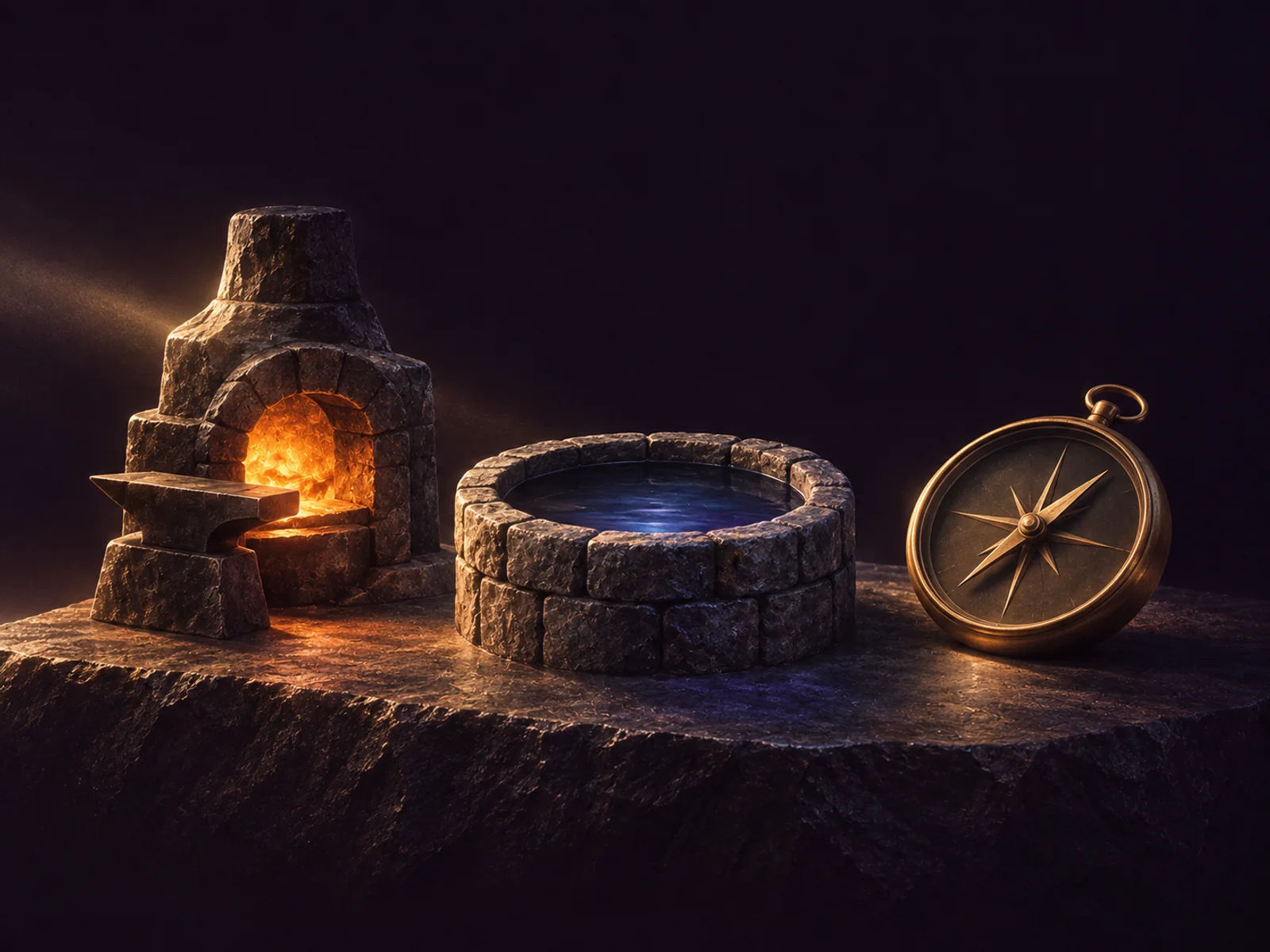
What you'll learn from your Loretype
- A leading Loretype, so you can compare it with the King, the Warrior, the Magician or the Lover if that vocabulary helps
- A supporting type from a second axis, which often explains why one masculine archetype never feels like the whole picture
- A growth edge, offered as a prompt to explore and never as a flaw, a test of toughness, or a measure of manhood
- A five-axis map you can keep private or share by link, without an account or any question about your gender
Example result on the male archetype test
An illustrative result from fixed example answers, not your personal result.
Leading: The LensSupporting: The Craft
- Agency65.0 / 100
- WeaverForge65.0 on the Weaver to Forge axis; 50.0 is the midpoint.
- Horizon35.0 / 100
- AnchorPathfinder35.0 on the Anchor to Pathfinder axis; 50.0 is the midpoint.
- Sense90.0 / 100
- PulseLens90.0 on the Pulse to Lens axis; 50.0 is the midpoint.
- Make20.0 / 100
- CraftSpark20.0 on the Craft to Spark axis; 50.0 is the midpoint.
- Presence55.0 / 100
- WellBeacon55.0 on the Well to Beacon axis; 50.0 is the midpoint.
50.0 is the midpoint on each axis; neither end is better. The strongest lean leads, and a different axis supports it.
In this illustrative result, The Lens leads and The Craft supports. Presence sits closest to the middle, so it is the growth edge. Someone with this pattern might recognize the Magician's attention to hidden detail and the Warrior's discipline in how they check facts and then finish the work.
That is a conversation starter, not a label. The quiz never tells you that you are a King or a Warrior, and the same answers would give the same result on any entry page.
Masculine archetypes: King, Warrior, Magician, Lover
The phrase masculine archetypes most often points to one book: King, Warrior, Magician, Lover: Rediscovering the Archetypes of the Mature Masculine by Robert Moore and Douglas Gillette (HarperSanFrancisco, 1990). Writing in the Jungian tradition, the authors describe four forms of mature masculine energy. For each, they also describe two shadow poles, one inflated and one collapsed.
It is a popular psychology book, not a validated instrument, and it reflects one cultural reading of masculinity. Some readers find parts of it dated. Nothing here is exclusive to men, and the four figures are offered as lenses you can pick up or put down.
The King
Moore and Gillette link the King to order, steady leadership and the ability to bless others by recognizing what they bring. They name the shadow poles as the Tyrant and the Weakling. By our editorial mapping, the King is closest to The Forge and The Anchor.
The Warrior
The Warrior stands for discipline, focus, skill and commitment to a cause beyond the self. The shadow poles in the book are the Sadist and the Masochist. By editorial mapping, the Warrior's discipline sits closest to The Craft and The Forge.
The Magician
The Magician stands for insight and the knowledge to see beneath the surface of a situation. The shadow poles are the Manipulator and the Denying Innocent One. By editorial mapping, the Magician is closest to The Lens and The Spark.
The Lover
The Lover stands for feeling, sensitivity and a deep connection to people, beauty and the world. The shadow poles are the Addicted Lover and the Impotent Lover. By editorial mapping, the Lover is closest to The Pulse and The Beacon.
These matches are editorial mapping by Loretypes, made to connect older vocabulary to ten patterns. They are not findings from research, and they are not part of Moore and Gillette's work. A Lens result does not make you a Magician, and one Loretype can sit near several figures.
Source: Robert Moore and Douglas Gillette, King, Warrior, Magician, Lover: Rediscovering the Archetypes of the Mature Masculine (HarperSanFrancisco, 1990). For the wider background on archetypes, see the guide linked below. Read the Jungian archetypes guide for all twelve classic archetypes.
The ten Loretypes
Five bipolar dimensions map to ten types. Each type page explains the pattern, neighboring types, and a growth prompt.
All Loretype guides
Archetype learn guides
How this free archetype test works
On this male archetype test you rate 24 statements from strongly disagree to strongly agree. The scoring matches every other entry page, and no gender is asked or saved. Your result names a leading Loretype, a supporting one, and a growth edge. Treat the King, Warrior, Magician and Lover notes above as a second vocabulary: use a word if it helps you describe your pattern, and drop it if it does not.
- 1
Rate 24 short statements from strongly disagree to strongly agree, one screen at a time, choosing the response that feels most true right now.
- 2
The server reverses some items, totals five bipolar dimensions, and names a dominant type, a supporting type, and a growth edge from those leans.
- 3
You receive a complete free result you can share: identity, supporting pattern, growth edge, and the full five-axis picture. No email wall.
Five dimensions, ten types
Every question belongs to one of five axes: Agency, Horizon, Sense, Make or Presence. Your answers lean toward one pole of each. Nothing on these axes is gendered, so a Weaver, Pulse or Well result can come from anyone. The framework notes above are only a bridge to vocabulary you may already use.
- Agency: The Forge · The Weaver
- Horizon: The Pathfinder · The Anchor
- Sense: The Lens · The Pulse
- Make: The Spark · The Craft
- Presence: The Beacon · The Well
Frequently asked questions
Which masculine archetypes does this page cover?
It covers the four archetypes in Moore and Gillette's King, Warrior, Magician, Lover (1990). Each is matched to the closest Loretypes through our own editorial mapping, which is a reading aid and not part of the book.
Does the test rank men by strength or status?
It does not rank masculinity, dominance, desirability, or social value. Both ends of every dimension are valid preferences. A quieter result is not a lower grade, and a leading pattern does not make someone a better partner or leader. Read the names as prompts for observation rather than badges to earn.
Can I get a caring or collaborative type here?
Yes. Every one of the ten types is available from this entry. Listening, collaboration, analytical thought, and initiative are human behaviors rather than gender assignments. This page changes the introduction to address your search, while the actual quiz and all result explanations stay shared with the general entry.
Is my Loretype the same as King, Warrior, Magician or Lover?
No. A Loretype describes a lean in your answers on five axes. King, Warrior, Magician and Lover are figures from a 1990 book. We map them loosely, so you may see yourself in two figures or none, and either is a fine outcome.
Do I need to be a man to take the male archetype test?
No. Anyone can take this test. The page is a search-friendly doorway into the same 24 statements, with notes on the Moore and Gillette framework. The quiz is free, with no email, and the complete result is available to read without an account.
Anyone can take this test. Three to four minutes is all it takes.