What Is Seasonal Color Analysis?
A guide to seasonal palette language, the differences between four and twelve seasons, and the limits of a preference quiz.
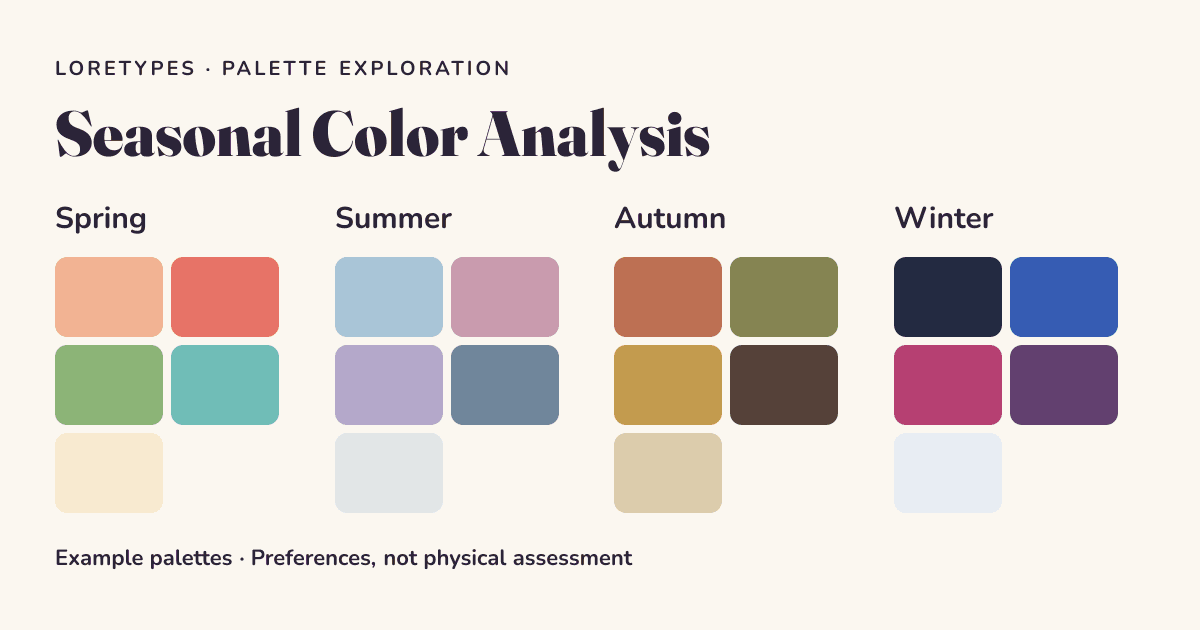
What is seasonal color analysis?
Seasonal color analysis is a styling framework that groups palettes under seasonal names. In styling contexts, people may compare how different colors look together or alongside a person. Here, we use its palette vocabulary for an entertainment and self-reflection exercise. A questionnaire about preferences cannot establish physical coloring.
The useful part is a shared language: you can describe a combination as warmer, lighter, clearer, or more contrasted. None of those descriptions makes one palette better than another.
Four seasons and twelve subtypes
Spring, Summer, Autumn, and Winter are broad palette families. A twelve-part approach divides each into three emphases: Spring has Light, Warm, and Bright; Summer has Light, Cool, and Soft; Autumn has Soft, Warm, and Deep; Winter has Deep, Cool, and Bright. Names vary between guides.
The subtypes are not twelve equally separated boxes in nature. They are labels for overlapping combinations. Soft Summer and Soft Autumn, for example, both give muted color a central role while differing in warmth.
How this quiz uses the four axes
Temperature means a preference for cooler or warmer color combinations. Depth asks whether you enjoy lighter or deeper bases. Clarity compares softened, muted colors with clearer, brighter ones. Contrast describes how much difference you like between colors in a combination.
The quiz has six statements per axis, including statements pointing in opposite directions. Five-point answers form four preference coordinates. Our fixed editorial rule chooses the nearest of twelve palette profiles with equal weight on each axis. This is a design choice, not a validated measurement of your features.
When answers stay near the middle, the result is marked tentative. When two different seasons are close, it tells you to compare them. A fixed ordering settles exact ties; being listed first does not make a palette more correct.
Try the color season quiz →Try a palette without replacing your wardrobe
Choose one neutral and one accent you already own. Keep the setting, shape, and fabric as similar as possible, then change just the accent. Ask whether you enjoy the combination and would use it again. Your preference is the useful observation.
Screens, lighting, context, and the examples you imagine can affect a comparison. Save a few combinations you like and revisit them later. If the result feels restrictive, borrow an idea from another season rather than trying to defend your first label.
How palette language differs from aura language
A seasonal palette describes color combinations in this activity. Aura descriptions on this site use color symbolically for self-reflection. One does not verify or predict the other; see how we describe auras for that separate context.
This quiz explores palette preferences. It does not measure your skin tone or physical features, and its result is a starting point for trying colors you enjoy.
Continue exploring with the color season quiz, the Spring palette guide, and the Summer palette guide.
Questions about seasonal palettes
Can a preference quiz replace a color comparison?
No. A quiz records what you say you like. Trying combinations lets you observe your own reaction to specific colors, textures, and contexts. Use the quiz as a starting list of ideas.
Can my color season result change?
Yes. Your answers can change with your taste, mood, or the combinations you imagine. A different quiz result reflects those answers, not evidence of a physical change.